Research
EPSRC: Hybrid lightweight structural systems for low-cost housing (HYLIGHTS)
- Conducted computational and experimental research in structural resilience and lightweight structural systems, including parametric finite element modelling, optimisation, machine learning and data-driven analysis.
- Collaborated with researchers at Imperial College London, the University of Sheffield and Politecnico di Milano, contributing to peer-reviewed publications and international conference dissemination.
- Contributed to undergraduate and postgraduate teaching, research supervision and industry-engaged structural software development.
PhD Dissertation: Performance-based seismic design of hybrid lateral force-resistant resilient system comprising HS-MRF and SC-CPSW
Abstract
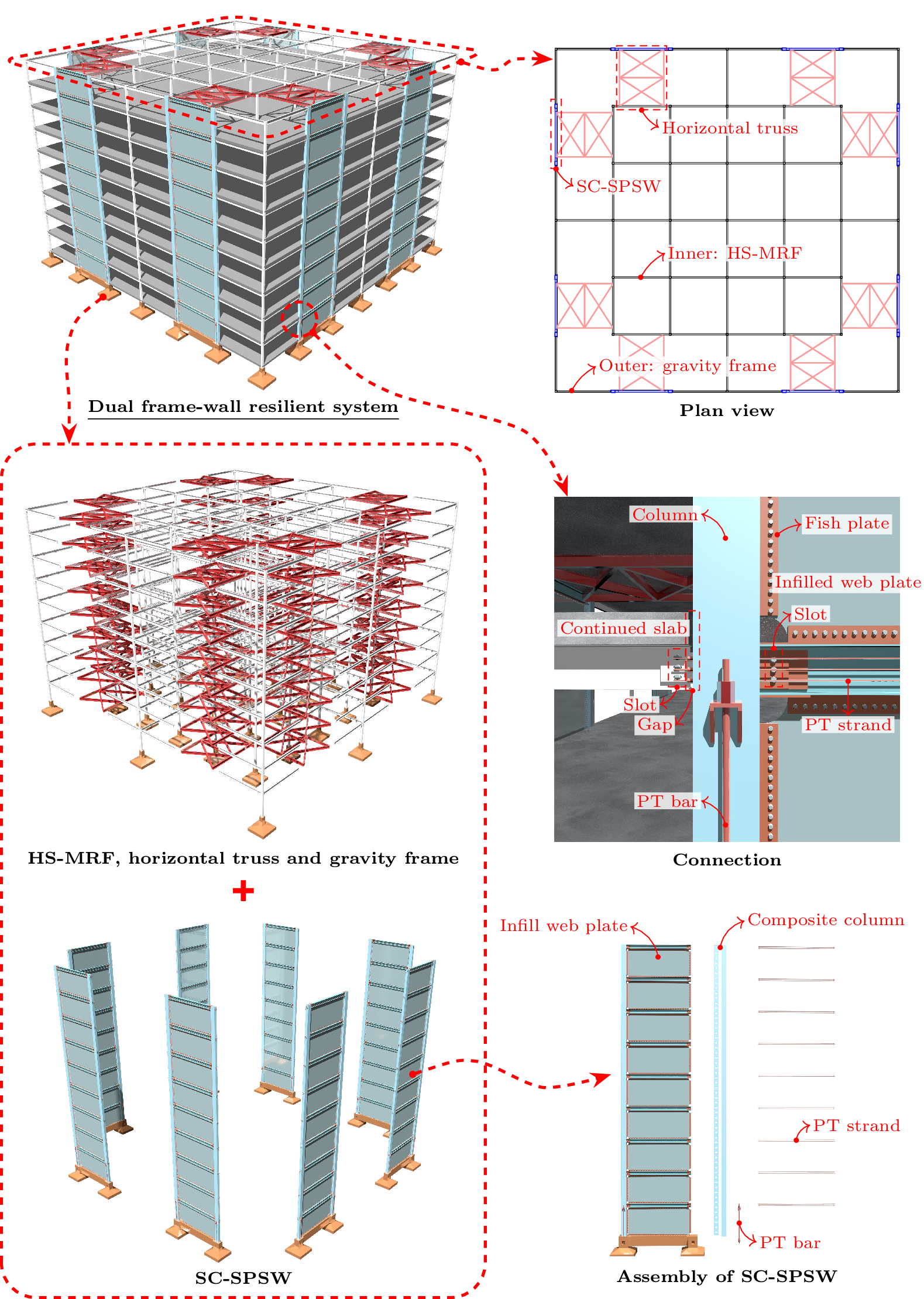
The emergence of frame expansion due to excessive rocking can lead to conflicts between subsystems within self-centering structures. Besides, the performance-based seismic design method is heavily reliant on the structural displacement responses. To address these challenges, a hybrid lateral force-resisting resilient system, comprising high-strength moment-resisting frames (HS-MRF), self-centering steel plate shear walls (SC-SPSW) and gravity frames, was introduced. Subsequently, a conceptual damage-control design was proposed, and was verified by comprehensive studies involved cyclic tests, finite element analysis, pushover analysis and nonlinear steady-state dynamic analysis. Additionally, a four-fortification performance-based seismic design method was proposed based on the modified direct displacement-base design (DDBD) method, after the developments of displacement profile and equivalent viscous damping through enormous nonlinear time-history (NLTH) analyses. Primary work and outcomes in this dissertation are as follows.
A conceptual damage-control design was developed, following by investigation on seismic performance and design requirements of SC-SPSW through cyclic tests and finite element analysis. The conceptual damage-control design encompasses four performance levels including immediate occupancy (IO), damage control (DC), life safety (LS) and collapse prevention (CP), based on the lateral force-resisting mechanism of HS-MRF and SC-SPSW. Additionally, the structural mechanism of SC-SPSW considering the frame-expansion effects and a simplified frame-expansion analytical method were investigated and verified. To confirm the conceptual damage-control design, cyclic tests of seven 1/3 scaled two-storey single-span SC-SPSWs were conducted, considering the use of infill web plate, the parameters of post-tensioned (PT) elements and gravity effects. Moreover, finite element analysis of three specimens and parametric studies on gravity load, the thickness of web and initial PT stress ratio and section area of PT elements were also carried out. Findings demonstrate that the residual drift of all specimens remained within the acceptable limits, and the boundary elements maintained their elastic responses, despite the persistence of the frame-expansion phenomenon, underscoring the success of the conceptual damage-control design. Furthermore, the results of finite element analysis aligned with the testing results, in terms of structural strength, lateral stiffness, and the progression of damage.
Multi-degree-of-freedom (MDOF) model were developed, and solutions to the steady-state nonlinear dynamic responses were proposed. Adaptive Modal Pushover (AMP) analyses were conducted on the verified MDOF model to study the lateral performance of hybrid lateral force-resisting resilient system, where the HS-MRF and SC-SPSW were represented by a bilinear hysteretic model and the superstition of self-centering model and the proposed pinching4M model, respectively. Besides, a drift concentration factor was employed to analyse structural lateral responses, revealing that storey drift can become concentrated as a result of web plate failures, and the relationship between the lateral force-resisting force of the subsystems and the stiffness ratio is significant. Additionally, the method of averaging was employed to obtain a general analytical solution for a single-degree-of-freedom (SDOF) nonlinear oscillator subjected to harmonic excitation. Subsequently, a stability analysis was conducted to assess the behaviour of general singular points. Subsequently, the steady-state responses of the individual hysteretic models including the previous bilinear, self-centering, and pinching hysteresis models were investigated independently before conducting a comprehensive system-wide analysis. The results shed lights on the nonlinear dynamic mechanism of the hybrid lateral force-resisting resilient system and confirm the successful design of the subsystems.
Four-fortification performance-based seismic design approach was proposed, after the development of displacement profile and equivalent viscous damping ratio model. Substantial NLTH analyses were performed on the proposed MDOF model, based on a dataset comprising 384 prototype buildings designed with different storey numbers, length of structural span, post-yielding stiffness ratios and fundamental periods, yielding a displacement-profile model. Besides, extensive NLTH analyses were also conducted on the SDOF models, accounting for the fundamental period, ductility, stiffness ratio of subsystems and post-yielding stiffness ratio, giving a equivalent viscous damping model under the guidance of equivalent linear SDOF systems using secant stiffness. Subsequently, a ductility-period displacement spectrum was introduced, unveiling a modified DDBD approach. This advancement led to the development of four-fortification performance-based seismic design method for the hybrid lateral force-resisting resilient system, which considers four different seismic fortification levels including frequent earthquake (FE), design earthquake (DE), rare earthquake (RE) and very rare earthquake (VRE). To demonstrate the practical efficiency, this approach was applied to the design of 6-storey and 11-storey buildings, respectively, underscoring its efficacy and applicability.